
UAE Researchers Turn Desert Sand Into Low-Energy Construction Bricks
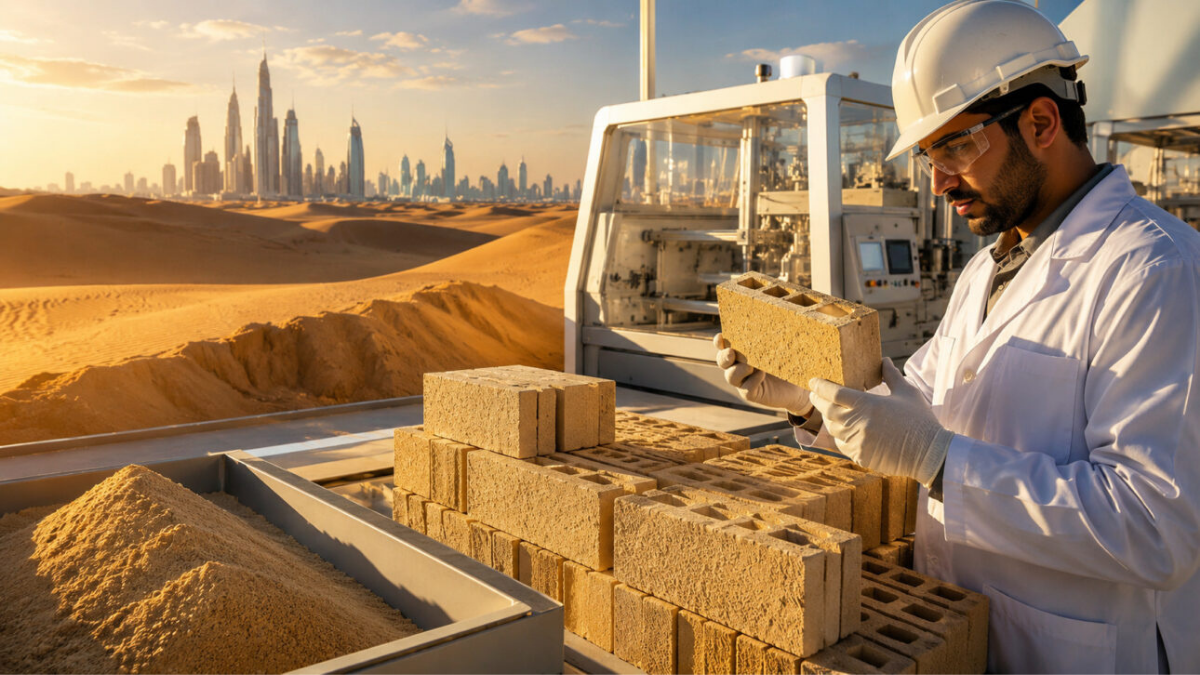
DUBAI, August 29, 2026: Researchers in the UAE have developed a new type of construction brick using desert sand and alkali-activated binders, potentially offering a more sustainable alternative to conventional cement-based building materials.
Scientists from the University of Sharjah produced and tested masonry bricks using locally available desert sand. The research explored whether the material could deliver the strength and durability required for construction while reducing dependence on conventional Portland cement.
Bricks Harden Without Additional Heating
One of the key findings was that the laboratory-produced bricks could be cured under ambient conditions, meaning they did not require additional heat to harden.
This could help reduce the energy consumed during the production of construction materials compared with manufacturing processes that rely on elevated temperatures.
Industrial By-Products Can Be Used
The alkali-activated binders investigated by researchers can incorporate industrial by-products such as fly ash and ground granulated blast-furnace slag.
Using these materials could reduce reliance on ordinary Portland cement, whose production is associated with significant energy consumption and carbon dioxide emissions.
Promising Durability Results
The researchers tested the bricks for mechanical strength, water absorption and durability. The tested formulations also showed promising resistance to sulfate exposure, an important property in environments where sulfate-rich soil or groundwater can damage conventional cement-based materials.
Could Reduce Reliance on Imported Materials
For the UAE, the approach could have a particular advantage because desert sand is widely available locally. If the technology can be scaled successfully, using local sand and industrial by-products could reduce the need to transport suitable construction materials from elsewhere.
However, the bricks are not yet established as a commercial replacement for conventional construction products. Larger-scale manufacturing, cost analysis, performance testing and further environmental assessment will be required before widespread adoption.
Why It Matters for Construction
The research combines three potential advantages: locally available desert sand, industrial waste materials and ambient-temperature curing. Together, these could eventually support lower-energy construction and reduce dependence on conventional Portland cement.
For the UAE's rapidly expanding construction sector, the technology could offer a new way to turn an abundant local resource into a useful building material while potentially reducing the environmental footprint of construction.