
Land Pooling Can Double Property Value But Most Buyers Don't Know How It Works
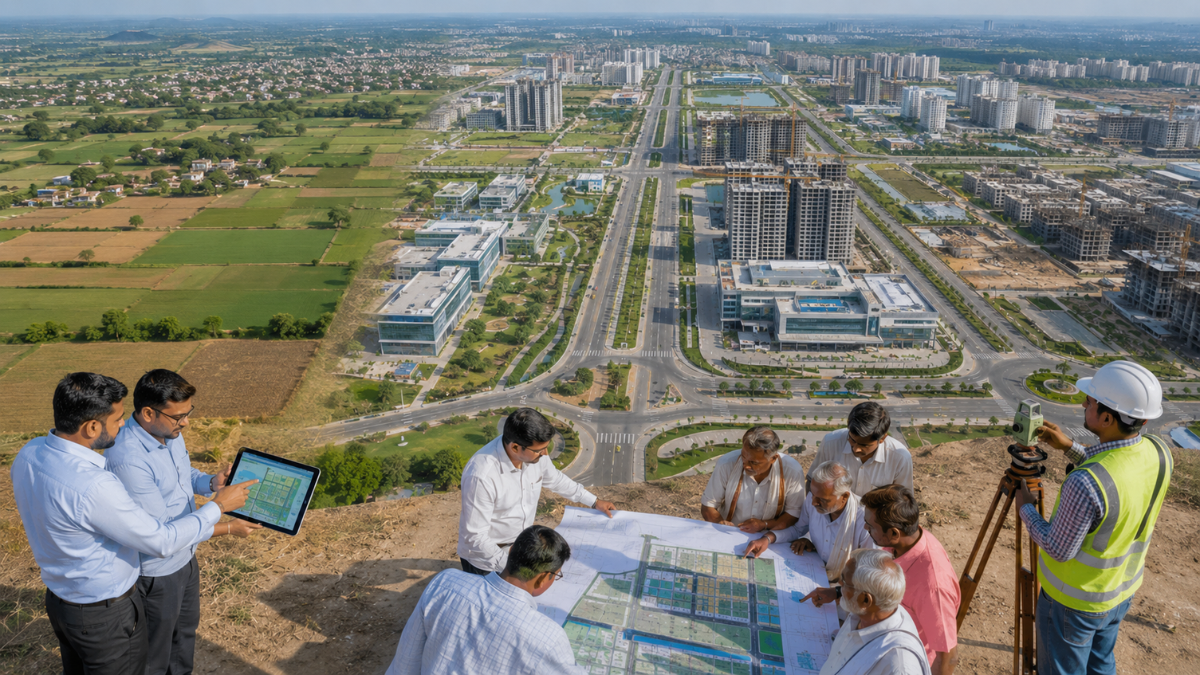
Imagine owning a piece of agricultural land worth ₹40 lakh today.
A few years later, the government develops roads, parks, drainage, water pipelines and commercial zones around the same area. Instead of losing your land through acquisition, you receive a smaller but fully developed plot.
Its market value could become significantly higher than the original undeveloped land.
This is the basic idea behind Land Pooling, a planning model that is quietly transforming the way Indian cities expand.
Yet, surprisingly, many homebuyers and even landowners still don't fully understand how it works.
Why Governments Are Moving Away from Land Acquisition
For decades, large infrastructure and housing projects relied on compulsory land acquisition.
The process often led to lengthy legal disputes, compensation disagreements and years of project delays.
Land pooling offers a different approach.
Instead of buying land outright, authorities bring together land from multiple owners, develop the area with roads and public infrastructure, and then return a portion of the developed land to each owner.
The remaining land is used for roads, schools, parks, hospitals and other public facilities.
Why Many Landowners Support It
Although owners receive a smaller plot than they originally held, the returned land is usually part of a planned urban layout with better infrastructure and improved development potential.
That often makes the developed plot more valuable than the larger undeveloped parcel it replaces.
For many owners, the long-term gain comes from better connectivity, higher demand and organised urban growth rather than the original land size.
Why Developers Also Like Land Pooling
Developers prefer planned growth over scattered construction.
When roads, utilities and public infrastructure are designed before buildings come up, projects can be executed more efficiently and buyers gain access to better-planned neighbourhoods.
This is why several expanding cities have started adopting land pooling instead of conventional development models.
Cities Where Land Pooling Is Changing Real Estate
Land pooling is becoming an important planning tool in several parts of India, including:
- Delhi
- Pune
- Ahmedabad
- Amaravati
- Dholera
- Greater Noida
- GIFT City (through planned land development models)
Each project follows different regulations, but the objective remains the same—planned urban expansion with improved infrastructure.
Should You Buy Property in a Land Pooling Area?
Not every land pooling project becomes a success.
Before investing, buyers should check:
✔ Whether the scheme has received final approval.
✔ Which authority is implementing the project.
✔ Whether roads and utility work have actually started.
✔ Expected development timeline.
✔ Nearby infrastructure projects.
✔ RERA registration (if applicable).
Buying immediately after a project announcement may not always be the best decision. In many cases, waiting until implementation begins can provide greater clarity about future development.
Biggest Mistake Buyers Make
Many buyers purchase land simply because they hear a "township" or "land pooling" announcement.
However, an announcement alone does not guarantee rapid development or price appreciation.
The real value often depends on execution, infrastructure delivery, regulatory approvals and market demand.
Understanding these factors is far more important than following speculation.
Final Takeaway
Land pooling is changing the way Indian cities grow by allowing planned infrastructure without large-scale compulsory land acquisition.
For landowners, it can unlock the value of undeveloped land over time.
For homebuyers and investors, it offers opportunities—but only when projects move beyond planning and into actual execution.
The smartest investment decisions are based not on announcements, but on verified progress, infrastructure development and long-term urban planning.